2020-02-08

Revisited

  In 2016 -- based on the information from a Russian homepage -- I wrote a post entitled Sport? Duel?, about two nice sabres, which are shown below. 

Duelling sabres?!

 The Russian text claimed that they are duelling sabres: German (left) and Italian; also it provided a fairly detailed description of swords, and their specifications (overall length, blade length, width, weight). During past years much more information has been available on different training swords, so with a certain level of confidence I would say that these two sabres are Parise type swords (Model 1 and Model 2). 

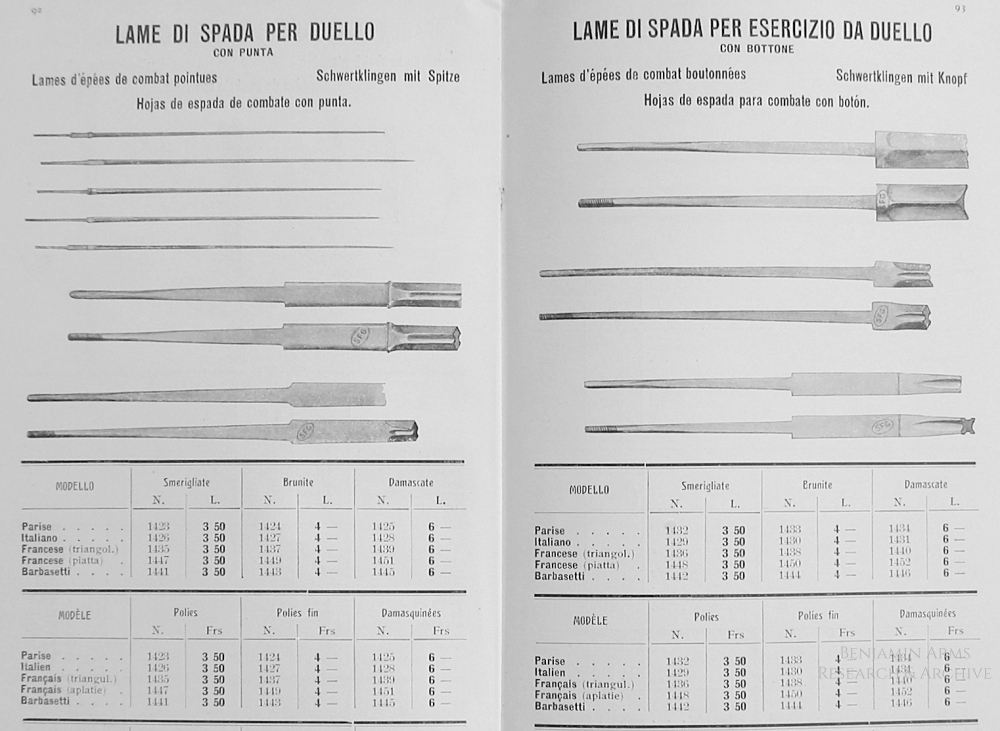
  Let's start with the second sword: an Italian duelling sword from the second half of the 19th century, according to the Russian description. It has a manufacturer's marking (SFG), [1] and an inscription can be read on the left surface of the blade „К ASANIELU PARISE”. This is a corrupted form of Masaniello Parise (1850-1910), famous Italian fencing master, director of Scuola Magistrale in Rome. This is his second model of fencing sabre.

 An excellent table [2] provides us with the very detailed information :

(108) 

Hilt type: ............................ Parise 2nd model
Blade type: ......................... Parise Curved 13 mm
Country: ............................. Italy
Owner: ............................... Sam Campbell

Blade length: ....................... 85.5cm
Overall length: ..................... 101.5cm
Fuller length: ....................... 51.5cm
PoB: ................................... 4.4cm

Total weight: ....................... 441g
Blade ................................. 169g
Guard ................................ 178g
Backstrap ........................... 0 ........ (because this grip doesn't have a backstrap)
Grip ................................... 38g
Ferrule ............................... 2x18g
Nut .................................... 24g

Curvature: ......................... 15mm
Width: ............................... 13.6mm (at ricasso)
Tip: ................................... 6mm
Thickness: .......................... 6.5mm (at ricasso)
Tip .................................... 0.6mm
Halfway.............................. 3.5mm

The Russian source gave us the following: overall length: 1028mm,  blade length: 857mm, width (presummably at ricasso) 19mm, total weight: 630g. So a sturdier blade with a Parise Mod. 2 hilt could have been used as a duelling sabre. [3]

  The first sword is said to be a German duelling sabre. The German origin is fully supported by marking „WEYERSBERG & STAMM SOLINGEN”. By studying different resources it is obvious that this hilt is Parise 1st model.

(7) 

Hilt type: ............................ Parise
Blade type: ......................... 18 mm
Country: ............................. Italy
Owner: ............................... Kevin

Blade length: ....................... 86.5cm
Overall length: ..................... 102.2cm
PoB: ................................... 12cm

Total weight: ....................... 596g
Blade .................................. 300g
Guard ................................. 205g
Backstrap ............................ 55g
Grip .................................... 26g
Ferrule ................................ 6g
Nut ..................................... 4g

Curvature: .......................... 15.22mm
Width: ................................ 18.67mm (at ricasso)
Tip: .................................... 12.43mm
Thickness: ........................... 5.39mm (at ricasso)
Tip ..................................... 1.53mm
Halfway............................... 3.95mm

  The Russian source gave us the following: overall length: 1012mm,  blade length: 846mm, width (presummably at ricasso) 16mm, total weight: 700g.

  So based on the above date we cannot exclude that these swords are indeed duelling sabres, but it is also quite clear that both hilts are Parise type hilts.
___________________________________________
  1. Italian manufacturer: SFG = Serafino Fratelli e Gnutti (A catalogue page.)
  2. Sabre Measurements. (Table.)
  3. In the table there is another Parise 2nd model -- owned by Stephen Fisher -- manufactured by Horster, which weights 635g.

2020-01-28

Old Hungarian

  There is very little public information -- especially actual measurements -- about old Hungarian training sabres between 1839 and 1896. These two dates are important, because they mark the publication of the first Hungarian fencing manual (1839) and the year when a large international fencing competition was held in Budapest, after which our sabre fencing was completely changed due to the influence of the Radaelli-system.

  So let's summarise what we do know about those practise sabres. First of all several Hungarian manuals describe them, provide us with drawings (Murz (1890), Gerentsér (1944)), sometimes even with a rare photo (Arlow)!


Arlow (1902): Fig. 1 -- Hungarian fencing sabre

  Unfortunately Arlow didn't tell us the exact specification for the (old) Hungarian practise sabres, he just noted the general requirements of fencing sabres used at competitions (total weight: at least 450g, usual blade length: 82-88cm, width at the shell: <17mm) (Page 7-8).

  In 2018 I had a pleasure to visit Árpád Németh's fencing collection, when Miskolc University's library borrowed several items from his magnificient collection, among them four swords. Naturally I was more than glad to measure those swords and share data with other sword enthusiasts. (According to Mr. Németh the first two swords were practise sabres, specifically for duelling, and the third one -- with Weyersberg blade -- was a normal training sabre). 

  Recently I have found an interesting auction lot [1], which looks very similar to Mr. Németh's Weyersberg sword. From the description provided by the auction house: „No marking on the blade. The total length: 99cm. Blade length: 84cm. Blade width measured at the shell is ~1.8cm.” [2] (The point of the blade is simply rounded.) Let's compare these measurements with those of Németh's sabre: blade length - 835mm, width at the shell - 17.5mm. So it seems that the sword on the following photos (fig. 2, 3, 5) has almost the same dimensions as the sword in Mr. Németh's collection.

Fig. 2

Fig. 3

Fig. 4: The sabre from Németh's collection

Fig. 5

 Soon there will be a short update of this post. „”
_________________________________________________
  1. Source.
  2. Régi gyakorló - vívó kard. Hüvely nélkül. Pengében jelzést nem találtam. Teljes hossza: 99 cm, penge hossza: 84 cm, penge szélessége a penge tövénél mérve kb. 1,8 cm. A képeken látható állapotban.” (Vatera)

2020-01-21

Eye candy

Fig. 1

Fig. 2

Fig. 3

Fig. 4

Fig. 5

 Not a terribly sophisticated post: just a few eye candies -- photos of a very nice training sword currently on sale at a Hungarian auction house.
________________________________________
  1. Source.

2020-01-18

Balp Fils

 One page from a French catalogue of fencing equipment. [1]

  • a wooden sabre (beech), wire knuckle bow (15 francs); [2]
  • a wooden sabre (beech), steel guard (18 francs);
  • Radaelli type training sabre;
  • Parise type training sabre, with wooden grip;
  • Masiello type training sabre, wooden grip with a backstrap;
  • Sestini type training sabre, wooden grip with a backstrap. [4]
  This French sword manufactured -- Balp Fils (Balp Jr.?) -- was established in 1830 at Saint-Étienne, and later was able to produced 5-6 thousand swords annually for different branches of the French armed forces and also civil administration. [3]


  Several blade markings can be found at different sword forums: B.F in an oval (French cavalry sword, ~1896), BF, between the letters there is a rapier hilt (probably an older version of Balp's marking).
__________________________________
  1. www.benjaminarms.com
  2. Without a wire knuckle bow wooden sabre costed only 10 francs.
  3. Littlegun.
  4. Other types of Italian sabre hilts can be seen in this post.

2020-01-07

Benedek Gyula

  Ez a bejegyzés idősebb Szigeti Benedek Gyula vívómesterről szól. [1] 

Gyászjelentése [2]

  Az országosan ismert vívómester 1908. február 18-án halt meg Debrecenben. Feleségét (szül. Rehacsek Ernesztint) alig két évvel korábban -- 1906. augusztus 8-án -- veszítette el, így meglehetősen pontatlan az „özvegységének 3-ik évében” szöveg, ezt érdemes tudni, amikor gyászjelentések alapján próbálunk kiszámolni dolgokat. Az idősebbik fia, Gyula és a fiatalabbik fiúgyermeke, Sándor is vívómesterek voltak; Gyula Miskolcon oktatott, Sándor meg Debrecenben.

Az 1901. április 20-i verseny hirdetménye [3]

  Az I. világháború kitörésekor mindketten önként jelentkeztek harctéri szolgálatra. Sándor népfelkelő tizedesként 1914. szeptember 9-én járőrszolgálat közben halt hősi halált a szerb fronton, 39 éves volt (1875?–1914). Az öt évvel idősebb Gyula mint tanárember besztercebányi 16. népfelkelő gyalogezred kötelékében szolgált, túlélte a világháborút, 1919-ben a cseh légiósok előrenyomulását akadályozta meg Rimaszombat környékén. [4]

  De lássunk az idősebb Szigeti Benedek Gyula igen színes életútját!

  1841-ben született Torontál vármegyei Nagybecskereken, 39 évesen pompás formában volt: „közép magas, szívós testalkattal: súlya 78 kg. mellbősége 105 cm., karvastagsága 40 cm.; 10 percz alatt 1000 moulinét képes kivágni; a vívásban kitartása átlag folyton tartó küzdelmekben 30 percz”. Már gyermekkorában kedvelte a vívást, 1861-ben jelentkezett bécsújhelyi központi vívóintézetbe (Militär-zentralfechtschule), egy évnyi tanulás után, még két éven keresztül segédvívómesterként tanított az intézményben. [5] Megpróbáltam további adatokat találni Benedek katonai pályafutásáról, és arról, hogy ténylegesen mikor volt katonai oktató Bécsújhelyen (Wiener Neustadt). Annyit sikerült kideríteni, hogy 1860-ban már kadét volt az IR. Nr. 37-ben, vagyis a 37. gyalogezredben, és még abban az évben átkerült a 6. gyalogezredhez. [8] 1861 és 1863 között az ezred kadétja („Cadeten. [...] Benedek, Julius v.”), [9] majd 1864-ben eltűnik a névsorból, közben nem jelenik meg az 1853-ban alapított, bécsújhelyi Militär Lehrer Institut névjegyzékében, [10] igaz abban csak a vívómesterek szerepelnek. Úgy érzem, néhány komolyabb kérdőjel merült fel Benedek katonai éveivel kapcsolatban. Tényleg tiszt volt? A huszároknál??

 Számos ismert küzdelme volt a kor nevesebb vívómestereivel. Erről több érdekes hozzászólás született a vívótopikban: Valami a vívásról, Hartl, Kiterjesztett keresés stb. Most ezeket nem akarom részletesebben átvenni és kiértékelni, inkább egy rövidebb összefoglalóval zárnám a bejegyzést.

Vívó Híradó (1974) [7]
Summary:
 A short biography of a lesser-known Hungarian fencing master Gyula Szigeti-Benedek (1841–1908), his sons – Sándor and Gyula – who were also fencing masters.
________________________
  1. Nem tévesztendő össze az azonos nevű fiával: ifjabb Szigeti Benedek Gyulával. Sajnos számos helyen az ő fényképe került az apjáról szóló cikkekbe. Még 2016-ban az unokája többször írt a honlapot üzemeltető társaságnak, de még tegnap is ez a kép szerepelt az életrajzokban. :-(
  2. Hungaricana (Gyászjelentések).
  3. Benedek Sándor Debrecenben szervezett egy országos versenyt. A Debreceni Városi Színház plakátja.
  4. Unokája adatgyűjtése. Elképzelhető, hogy ez az unoka írt a topikba is.
  5. A topik egyik hozzászólásában idézett Vadász és Versenylap.
  6. Militärzentralfechtschule (1853–1868).
  7. Klell Kálmán: Egy híres vívómester a múlt század végén. Vermes Lajos tündöklése és hanyatlása.
  8. Militär-Schematismus des österreichischen Kaiserthumes (1860) Kiegészítés: „Veränderungen während des Druckes.” (Nyomtatás közben történt változások.)
  9.  Schematismus (1861-1862), 145. o.
  10. Az intézmény teljes neve: Militär-Lehrer-Institut und Central-Fechtschule .
  11. 6. Infanterie-Regiment (Neusatz), 1762 als zweites Szekler Grenz-Infanterie-Regiment Nr. 15 neu errichtet.”

2020-01-04

Breaking

  Is it possible to break a steel sabre on your knee?

 There is an interesting and emotional scene at the end of Born for the Sabre docudrama: the protagonist, Blazej Wronowski, Polish nobleman is breaking the steel blade of a sabre on his knee.


 It seems that this is the biggest blunder of Zrodzeni do szabli, remarkably nicely filmed and well directed Polish dramatised TV film. Let me explain why I think so. At the moment I don't have at my disposal any technical calculations to prove the physical impossibility for a human being to perform such a feat, but we know from the historical records how such things were actually performed.

  „A New York Times article on the “Degradation of Dreyfus” on Jan. 6, 1895, reveals the answer: “To prepare for stripping the prisoner of his insignia of rank, the prison tailor yesterday removed all the buttons and stripes from Dreyfus’ tunic, the red stripes from his trousers and the regimental number and braid from his collar and cap. These were all replaced with a single stitch so that they could be torn away readily. The condemned man’s sword was also filed almost in two, in order that it might be easily broken. The Adjutant’s quick movement and apparent effort in breaking the sword was consequently mere pretense, as only a mere touch was necessary.”” [1]

  Another good example is the degradation ceremony (cashiering) of officers who participated in the Decembrist revolt (1825).

A. Dolinin [2]

  In this Russian text Dolinin quotes from the Jakusin's memoir [3]: „...I was the first on whom the  execution (of the degradation ceremony) started. The sword, that should have been broken above me, was inappropriately filed; the soldier hit my head with full force, but it didn't break; I fell. „If you repeat this again, you will definitely kill me” - I told him.” [4]

  From the above sources it is absolutely clear that only after having filed -- almost completely -- the blades those sword were broken. But when the filing was not performed carefully enough, swords were broken only after several attempts, and by applying considerable force.
____________________________________
  1. Source.
  2. Александр Долинин: Комментарий к роману Владимира Набокова «Дар». 2018. ...........(A. Dolinin: Commentaries to Vladimir Nabokov's novel The Gift.) Dolinin is a historian of Russian literature.
  3. Some sources say Jakusin, some say Jakubovich was the officer.
  4. During his military service in Caucasus he had a serious head injury.

2019-12-28

Keglevich

  Keglevich gróf híres párbajáról már volt egy bejegyzés 2015-ben, de most véletlenül megtaláltam az eset szépirodalmi feldolgozását egy másik gróf regényében. [1]

Komor esemény. Egy tragikus végű párbaj.

 Egyik újonnan választott kormánypárti képviselő az öreg Keglevich István volt. Úgy tudta mindenki: őt ültette volna Tisza az elnöki székbe, ha a választások többséget hoznak neki. Ő lett volna az, aki ama novemberben erőszakkal kikiáltott házszabályoknak érvényt szerzett volna. Ezért vállalt mandátumot először életében.

 Valóban alkalmas volt erre a szerepre. Vakmerő és erőszakos. Igen nagyeszű és parancsoló egyéniség. Kegyetlen, mint valami reneszánsz „tiranno”, és nagyúr is, bár számos gazdasági és művészeti vállalkozásaiban tönkrement. Tönkrement jórészt azért, mert a korát tíz-húsz esztendővel mindig megelőzte, akár erdőt ültetett, akár konyakgyárat alapított, vagy színházat, mindig ráfizetett. És mindaddig fizetett mindenki helyett is, míg végül semmije sem maradt egykor nagyon nagy vagyonából. Sok éven át intendánsa volt az állami színházaknak; ott is kiváló volt, és ezt honorálta Ferenc József, midőn kegydíjat rendelt neki, tekintve, hogy ez állami szolgálat, de nincsen nyugdíja. – Ebbe kaptak bele az embervadászok.

 Az igazoló jelentések során egyik szélsőbali szót kért. Megvádolta összeférhetetlenséggel, hogy a király bérében áll, hogy Bécs fizeti. Hát ez nagy öröm volt! Óriási hajrá! Senki sem gondolt arra, hogy az összeférhetetlenség megszűnik azonnal, ha a kegydíjáról lemond. De itt hecc kellett. Megbélyegzés kellett. Százan szörnyülködtek, kiabáltak, harsogtak az öregúr felé, akiből nem lett házelnök, aki nem ült föléjük, de ülhetett volna. Roppant örömet találtak abban, hogy a közel hetvenéves, nagy múltú aggastyánt becsmérelhetik és gyanúsíthatják. Száz torok üvöltött feléje. Ő pedig ült a legelső jobb oldali padban, még kifeszítve díjbirkózó szabású mellét. Olyan volt, mint valami hatalmas vadkan, melyet körülugat a kopófalka. Kihívóan előretolta amúgy is kiugró állát, szúró szemeivel kémlelte, hogy elkapja az első személyes sértést, amelyért elégtételt kérhet.

  Végül megjött az is. Egy újdonsült képviselő azt kiáltotta feléje: „Kegydíjas marha!” Azonnal kihívatta súlyos föltételű párbajra. Most is érvényesült az ő tirannus volta. Ezúttal a segédeivel szemben. Kikötötte, hogy csak a saját kardjaival verekszik, merev, széles kardokkal, melyek olyan hegyesek, mint a nyárs, és hogy bandázs nélkül és szúrással, bár ő régi magyar kardvívó volt – ezek csakis vágást ismertek –, míg az ellenfele olasz iskolát végzett, ahol a karddal való szúrást, a „punto d’arresto”-t tanítják. – Másnap az öreg Keglevichet holtan hozták el a vívóteremből. A „rajtá”-ra ifjúi lendülettel támadott. Az ellenfele hátrált, azután hirtelen általszúrta olyan erővel, hogy a kard a lapockája alatt jött ki túlfelől – leszúrta őt az a névtelen másik, aki kora szerint akár a fia lehetett volna.”

  Érdekes leírást kapunk Bánffytól a párbaj előzményeiről, Claim Vilmos nem írt ennyire részletesen az esetről, ő inkább a tényleges vívásra koncentrált. Próbáljuk elemezni az utolsó bekezdést:

a) a párbaj feltételei tényleg súlyosak voltak;
b) a használt kardok nem voltak különösen szélesek, merevek 
    (lásd a linkelt bejegyzés adatait);
c) az ellenfelén volt nyakbandázs („...az első vágást Hencz be is kapta 
    nyak-bandázsára...”);
d) az öreg gróf nem volt tirannus -- értsd makacs akarnok --, hanem teljesen 
    racionális megfontolásból választotta meg feltételeket (lehessen szúrni); [2]
e) nem az ellenfele volt rendkívül ügyes vívó, és szúrt hatalmas erővel, hanem
    a gróf veszítette el egyensúlyát és gyakorlatilag rádőlt a másik kardra;
f) természetesen a másik sem volt egy névtelen senki, hiszen parlamenti
   képviselő volt; Hencz Károlynak hívták, de kétségtelen hogy az 1877-es
   születésű néppárti honatya 37 évvel volt fiatalabb, mint Keglevich. 

  Kimondottan érdekes összehasonlítani egy szemtanú vívómester (Fodor Károly) beszámolóját és a párbaj szépirodalmi feldolgozását.

Summary:
  In 2015 I quoted a long description of the famous sabre duel between two Hungarian MPs in 1905. An eyewitness -- well-known fencing master Károly Fodor -- gave a detailed account of the deadly duel. A few days ago I found out how the same duel -- and its context (a heated debate in the parliament) -- was described in a novel by Count Miklós Bánffy. It is interesting to compare these two texts.
______________________________
  1. Gróf Bánffy Miklós: Erdélyi történet. Helikon, 2012.
  2. „...Holott ha bandázs nincs, és a kardhegy tiszteletre tanítja a handabandázót, biztosra vehetik sérthetetlenségüket. Teljesen érthető tehát, ha minden jó vívó ragaszkodik a szuráshoz. Ebből tehát Keglevichre nézve nem lehet semminemű konzekvenciákat elvonni” - írta egy újságcikk 1905 júniusában.

2019-12-16

...do szabli

  On Tuesday a long-awaited Polish film -- Zrodzeni do szabli (Born for the Sabre) -- will be shown on History Channel. Hungarian viewers will also have the possibility to watch this interesting documentary-drama about sabre fighting, the Polish-Lithuanian Commonwealth.

From IMDb (3 of 16 photos)

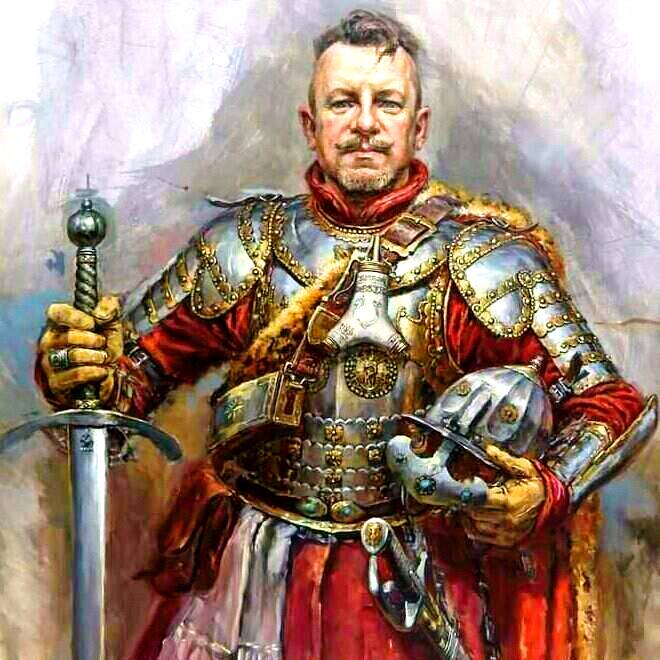
  It is very easy to find -- at least -- two trailers for this film, however in this entry I wouldn't like to discuss those excellent trailers, but rather I would prefer to share several nice drawings of painter-reenactor Anatoly Telenik, who worked on the film's concept.


And at this time we invite you to familiarize yourself with the conceptual drawings of Anatoly Telenik. Among other things, this is how it started! Everyone who wants to see the final effect are welcome in front of TV!” [1]


  First I saw these drawings in the YT video -- Zrodzeni do szabli | Fakty o polskiej szabli --, which explains the basic facts about the Polish sabre, but later I have found them on the film's FB-page. For the readers it might be interesting to find out more about Telenik, and see more of his excellent drawings.

Anatoly Telenik [2]

Update:
  After having watched the film it is really entertaining to re-examine the photo from IMDb.

 There we can see -- from left to right -- the several major characters: the protagonist, Blazej Wronowski (played by Bartosz Sieniawski),  Jan Jerlicz, war veteran and Blazej's fencing teacher (played by Pawel Delag, who also directed this film), and the antagonist, Russian bad guy, Dymitr Repnin (played by Krzysztof Sieniawski, identical twin brother of Bartosz). One would say it is completely charming how a little disguise -- some hair there, a shaved head here -- could make identical twins look so different. Well done!

  Bartosz holds in his left hand the upper part of the broken sabre from one of the last scenes.
________________________________________
  1. From the FB-page of Zrodzeni do szabli.
  2. Source.

2019-12-11

Sailors

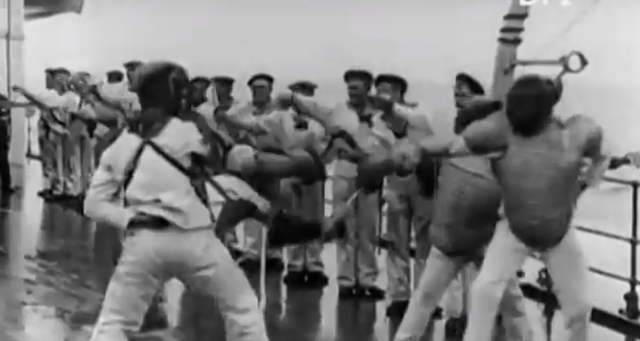
  While watching Matt Easton's video on British gymnasium sabres I got curious when I saw this photo depicting sailors fencing with singlesticks.

Sailors & singlestick [10:35]

  It is a fairly unremarkable picture: just sturdy fencing masks and proper torso & groin protection, absolutely suitable for this type of fencing. We can see almost the same equipment here: in an article from Chris Amberger's site: „This British “Oilette” postcard depicts young British sailor practicing with singlesticks aboard their ship, the H.M.S. St. Vincent, in 1896. The weapons consist of stout ash sticks with a semicircular guard made of stiff boiled leather. While the sword arm remains unprotected, head gear and plastron closely resemble that worn by German students for Schläger practice. The pad on the advanced knee indicates that the leg at that point was still considered a valid and worthwhile target.” [1] The only visible difference between the picture in Matt's video and the postcard from Chris' site: a knee pad on the front leg.

  But this unremarkable photo has reminded me of a discussion that we had roughly two years ago at our Hungarian fencing forum about the difference between current HEMA equipment and the protective equipment which sailors used at the beginning of the 20th century. Based on this photo a Hungarian guy claimed that the sailor's equipment was at least four times thicker than the current HEMA equipment used at fencing competitions. [2] The most prominent difference could be observed at the shoulders. He also linked a video showing the training of Danish sailors. So I have decided to see again that video and analyse it in a more careful way.

  The video shows us the bayonet & sabre fencing of Danish sailors in 1910 on the board of Herluf Trolle [3]. After the careful examination of several still frames from the video it is rather obvious that four times difference is highly unlikely. The apparent „thickness” of shoulder pads is absolutely clear from the following still frames.


  From a certain angle the vertical flap of shoulder protection -- marked with a red star -- could be seen as a very-very thick and bulky thing, but in reality it is not the case, as we can clearly see from the above pictures. So the protective equipment of Danish sailors in 1910 wasn't too different from the current HEMA gear; to be precise the fencing equipment of current HEMA sabre competitions is definitely sturdier and offers better protection than the sailors' equipment back in the 1910s.
_______________________________________________
  1. C. Amberger: Singlestick drill (1896)
  2. Szerintem csak úgy 4x akkora, mint bármilyen jelenlegi hemás versenyen látható cucc.” Post from the topic.
  3.  I am not completely sure is it the name of this ship or just a class of Danish naval ships.