Showing posts with label English. Show all posts

2023-06-15

Vendelhalom sabre

  A nicely restored sabre from the X-XIth century (Csongrád–Vendelhalom archaeological site). Only the damaged blade was found in a grave, without the hilt. The blade itself is rather short, roughly from the Conquest era, but with an interesting feature – the prominent elman, which is a sharpened, raised part of the backedge.


 There is another interesting peculiarity about this site: four sabres were found here. It is a lot from one archaeological location, only at Karos II site more sabres were discovered by specialists. 

Hungarian summary:

Megújultak a veretes múzeumi ritkaságok

 Herceg Zsuzsanna restaurátor szakszerű munkájának eredményeként egy-egy kelta hólyagos kar- és lábperec, egy honfoglaláskori sarkantyú és egy szablya nyert megújult, méltó külsőt. Az egy darabban, de igen korrodált állapotban megmaradt, immár kiegészített szablya Csongrád–Vendelhalom 10–11. századi temetőjéből származik.  

 A korabeli szablyák pengéje enyhén ívelt, alsó harmadukat kétélűre köszörülték, vagy – ahogy a múzeumi darabon is látható – a penge síkjából kiugró fokéllel látták el. A penge tövére általában csónak alakú, mindkét szárával a penge felé hajló keresztvasat húztak, melynek végei gömb alakúak voltak. A vércsatorna pedig – baljós nevével ellentétben – a penge rugalmasságát hivatott biztosítani. 

 A rendelkezésre álló adatok alapján a sír előkerülési körülményei bizonytalanok. Annyi azonban tudható, hogy ebből a férfi sírból látott napvilágot a korábban hónap műtárgyának választott három bronzlemezből kivágott fűrész alakú függő és egy átfúrt bizánci érem (utóbbi lelet a Déri Múzeum "Vikingek a Kárpát-medencében" c. időszaki kiállításán tekinthető meg 2023. május 7-ig). A temető tárgyi anyagát tekintve így is jelentős darabról van szó. Négy szablyát is ismerünk ugyanis Vendelhalomról - ennél többet csak a II. karosi temetőben találtak! Ez a kiemelkedő szám az itt élők katonai, stratégiai szerepére utalhat. Az egykori királyi hadiút a lelőhely közelében találkozott a böldi révtől futó úttal, így talán az itt élő népesség felügyelte a vámszedést és az átkelés biztonságát.

 A fegyver immár közel eredeti pompájában megtekinthető lesz a készülő kiállításunkban!” (Tari László Múzeum, Csongrád)

2023-02-04

Hungarian Warfare

 Three days ago a fascinating short documentary – In the saddle, on horseback - The art of war of the conquest-era Magyars – was released on YT.


 „The movie takes the viewer back to the 10th century, familiarizing him/her with the art of war practiced during the Hungarian conquest of the Carpathian Basin. The journey starts with the making of the weapons themselves, guides the viewer through their methods of use and ends with the analysis of the campaigns following the conquest. Thus, it discusses problematic aspects related to warfighting as practiced during the era.” 


 This documentary is the result of the long and fruitful scientific cooperation between archaeologists, historians and several groups of Hungarian reenactors (experimental archaeologists).  

A Hungarian light cavalryman

Heavy cavalry in the 10th century

2021-09-23

Gerevich Trophy

 Somewhere in February I had only this hazy, low-quality picture of a beautiful silver cup.
The Gerevich Trophy (1987)

 Several months later an article in a Hungarian online newspaper had helped me to track down the granddaughter of Aladár Gerevich, Sr. (1879-1947), who allowed me to copy the following nice pictures of the gorgeous trophy.


 After that it was really easy to find this article in American Fencing (1987/3) about the origin of the trophy: 

The Gerevich Trophy 

 The GEREVICH TROPHY is donated by Dr. Oszwald Tapolcsznyi [1] an alumnus of the Cleveland State University of Cleveland, in memory of his fencing coach, Maestro Aladar Gerevich, Sr. of Hungary. Maestro Gerevich was the father and coach of his son, Aladar Gerevich, Jr. the all time best Hungarian Sabre fencer, winner of 7 Olympic gold medals. (1 individual, and 6 teams). 

 The Trophy is being inaugurated at the Sabre Event of the #3 North American Circuit Event in Cleveland, March 1, 1987. This is part of the North Coast Challenge hosted by the Northern Ohio Division of The United States Fencing Association. The Trophy is to be maintained for 7 years, after which time it will be retired and placed on permanent display at the Cleveland State University. It will then be maintained by the Cleveland State University Sports Alumni Association and the CSU Fencing Coach.” (Page 22) 
_________________________
  1. Dr. vitéz Tapocsányi Oszvald (1918-1998) egy clevelandi temetőben nyugszik (West Park Cemetery). 1952-ben érkezhetett az USA-ba. A szülei is abban a temetőben lettek eltemetve. Oszvald Gabor Tapolcsanyi néven lett amerikai állampolgár. Miskolcon született 1918. március 8-án.

2020-12-19

Face mask (~1625)

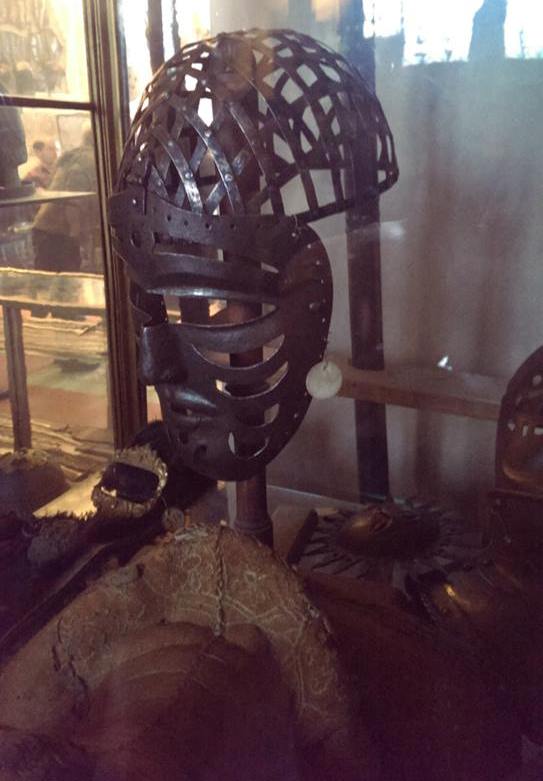
 It seems that the first known depiction of a plate fencing mask with ties is from 1686 [1] . However there are some tantalizing signs that protective masks were used several decades earlier. Below we could examine two face masks from the Stibbert Collection (Florence). The first mask is a rather interesting one, because it is difficult to say for sure: Was this mask a decorative one (resembling Venetian masks)? Or was it used for some other purposes e.g. fencing?!


 The second one, simply placed in a gorget by a curator or originally attached to a gorget, is especially interesting, because it matches really close the description of the object from the Pennsylvania Museum.


Purchase of European Armor

 The Museum's collection of European armor has been greatly strengthened by a recent purchase of fourteen specimens acquired at an important sale in New York. [...] The most striking piece in the group is a French fencing mask of 1625. It is embossed with the verisimilitude of a face with long mustachios and a Louis Trieze pointed beard; the mouth and eye openings have upraised borders, to deflect the stroke of the opponent's blade; the eyelids, beard, and mustachios are ornamented with roping.” (Page 24) [2][3]

Accessions October, 1921 - February, 1922
Class: ............... Armor
Object: ............ Fencing mask, French, 1625
Source: ............By purchase, Keehmle Fund and Bloomfield Moore Fund” (Page 29)
________________________________________
  1. Fencing Material Culture (2014)
  2. THE PENNSYLVANIA MUSEUM BULLETIN * PUBLISHED AT MEMORIAL HALL. FAIRMOUNT PARK, PHILADELPHIA, BY THE PENNSYLVANIA MUSEUM AND SCHOOL OF INDUSTRIAL ART NUMBER 70 FEBRUARY, 1922
  3. This bulletin is marked with a library stamp: „Philadelphia Museum, Library, College of Art”.

2020-09-26

How to...

 ...modify the tip of a plastic longsword (Red Dragon, RD) in order to make it more or less compatible with kendo headgear. We have been using a pair of synthetic longswords since May. They are absolutely great for beginners to learn the basics of the German longsword tradition (KDF), and also for light sparring (basically with nothing more than leather gloves and standard 350N masks).

 After a while, together with my fencing partner we have decided that it would be a good fun to fence with local kendo guys. More than 10 years ago -- as a complete beginner -- I fenced with them: shinai vs Olympic sabre. [1] But there is one big problem: shinai -- Japanese bamboo sword -- is really stiff (static flexibility somewhere between 17 and 22 kg), compared to Red Dragon's flexibilty (3.2-3.5 kg). So substituting shinais with plastic longswords while fencing with kendo guys is basically rather straightforward idea, but you have to overcome the next obstacle: the plastic blade could easily slide between horizontal steel bars of the kendo headgear (men), with obvious serious consequences (eye damage via blunt trauma). 

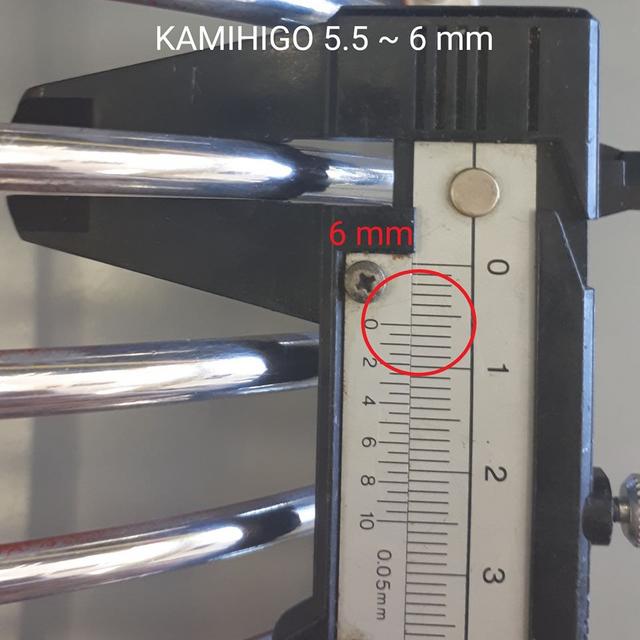
  The biggest distances between adjacent bars is 11-13 mm. [2]

Contours of RD's tip, width (23 mm),
thickness of the edge (6.5 mm)

 After taking into account all these details we thought the following modification would be sufficient to ensure relatively safe sparring with plastic longswords between a kendoka and a fencer. What we need for this? Only very basic stuff: a plastic cork [3], a piece of leather (approx. dimensions: length - 230 mm, width - 20-21 mm) and some insulation tape for securing the cork to the RD's tip.

 In this post I am using an aluminum blade (width: 30 mm) to show the process of the modification. I think that the pictures are definitely self-explanatory.


The final result

 After this modification we have a rather solid addition to RD's tip, whose dimensions -- thickness in one direction: 23 mm, in another: 31-32 mm -- might prevent the tip to enter any gap between mengane's horizontal bars. We have already tested one longsword with the modified tip against standard 350N fencing masks. It has survived two training sessions with any damage, also made thrusts with such a longsword less painful, because the modified tip is at least 3.7 times bigger than the original one. Naturally the final test will be the encounter between an empty kendo headgear and the modified longsword. 

Disclaimer:
 Everybody should be extremely cautious while fencing, especially during free sparring sessions between the representatives of different fencing schools. We are not advocating the usage of modified fencing equipment. Everybody performs such a modification, and uses the modified equipment at his / her own risks. The safest way to fence with plastic longswords is to use standard Olympic headgear for both the kendoka and the fencer. 
_____________________________________

  1. The YT-video of this encounter has reached almost 2 million views (1,981,461).
  2. Mengane.
  3. Diameter: 21 mm, height: 36 mm; it is advisable to split only the first 30-32 mm. 

2020-09-17

Filiberto Sauro

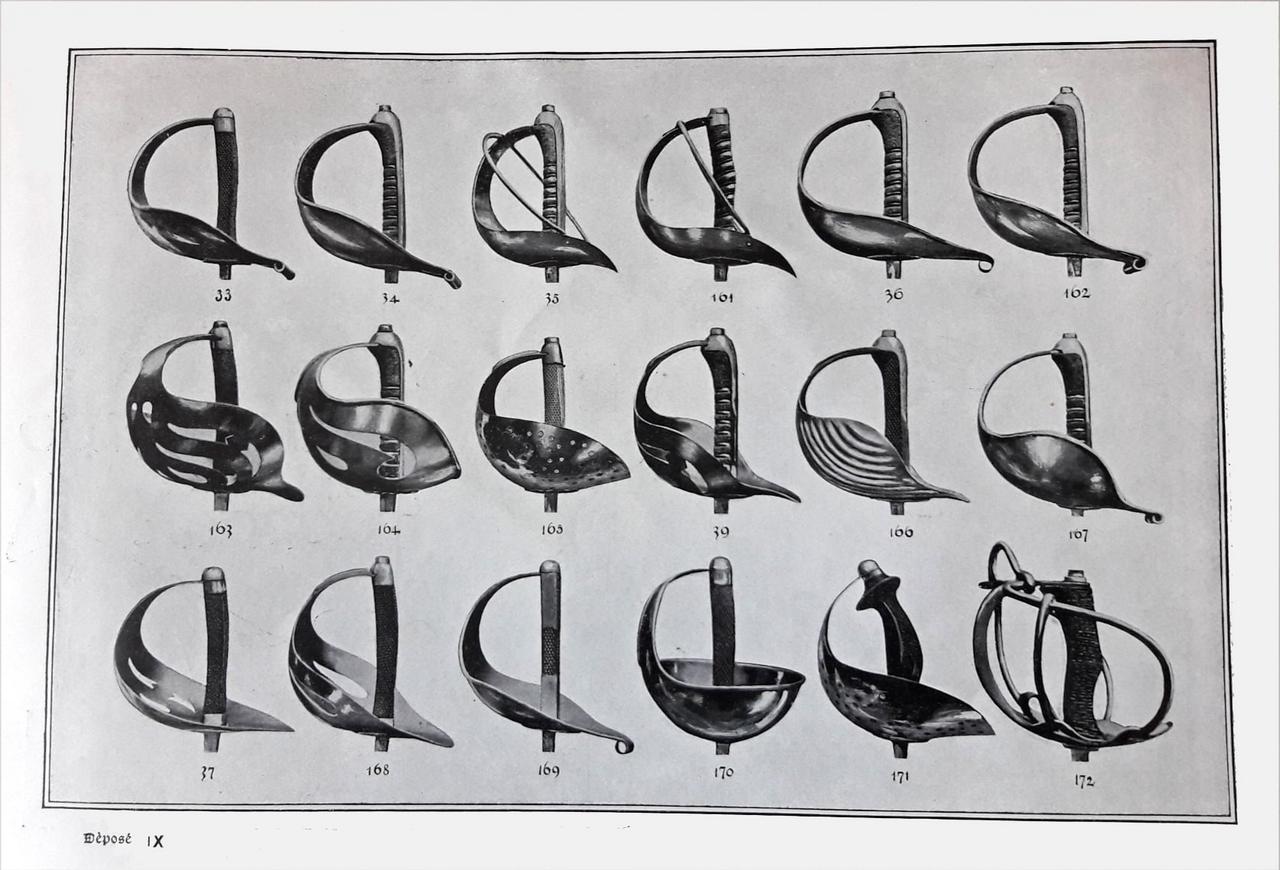
 It is really exciting to find a catalogue picture which shows such a rich assortment of fencing sabres. (A better picture.)

From Gerard Six FB-page [1] [2]

 I planned to use the previous blog entries in order to be able to identify as many sabre hilts as possible. But with some luck I have found that Chris Holzman made my life much easier by posting a pdf of Filiberto Sauro's printed catalogue (1932). Thus we can identify all sabres with absolute certainty. (Page 5 & 6 of the Italian catalogue.)

Page 5

Page 6

 The whole story just underlines the importance of mutually beneficial cooperation between HEMA-enthusiasts: Gerard Six had some good photos, but no text, and Chris Holzman had only text, without pictures. So by combining their goodies, now they -- and also the whole community -- have much better understanding which fencing swords were manufactured in Italy in the 30s.

Part of the last page
_____________________________________________________

  1. Originally it has been tentatively identified as a photo from the Sauro's catalogue.
  2. 1st row: Parise, Parise, Radaelli (35), Radaelli, Barbasetti, ???; 2nd row: Sauro, Bonna, Sauro, Masiello, Masiello, Baracco; 3rd row: ???, Sauro, Gennari, Galante, Tomazzoni, Mensur.

2020-08-29

Kazarla

 Very impressive cutting skills!!
 In 2019 Russian Cossacks were competing in cutting different objects. 


___________________________________________________
  1. В частности, до сих пор сами казаки используют в качестве самоназвания родовых, а не набранных и, тем более, ряженых казаков слова «казара», «казарра», «казарла», «козарлюги»” (Wiki) Even till now the Cossacks themselves use words kazara, kazarra, kazarla as  self-names for generic, not recruited Cossacks. 

2020-06-27

Strangest

 This might be the strangest sword I have ever seen so far... OK, to say ever can be a bit of exaggeration, but it is definitely true for this year. It could be the top nominee for the Strangest Sword of the Year award.


 I have found a short description of this item, and fours photos at an auction site [1] while searching for Chinese jians sword of Qin dynasty. So it is fair to classify it as a completely random find!


 The description from the auction site provides us with the following: „Lot 34 A RARE EAST EUROPEAN SWORD HUNGARIAN OR POLISH SECOND HALF OF THE 17TH CENTURY Broad flat double-edged blade with rebated tip the lower half etched on both sides with an heraldic crest surmounting a classical portrait bust and a Latin inscription differing over the respective sides with iron crosspiece formed with button tips and upper and lower langets flat beak-shaped cap-pommel canted downwards at its front original grip bound with leather over cords and the blade tang secured by a lateral rivet on iron rosette washers.

Overall length is 37.5 inches, 95 cm, blade: 32 ? inches (83 cm).
Very good condition. Blade has a chip towards the tip and minors scratches


 So what we have here? Basically a strange mixture of features:
  • a straight broad blade;
  • which is double edged;
  • and without a tip (rebated);
  • a very recognizable sabre hilt (a long crosspiece, langets etc).
 Also there is a well visible dent on the working edge of the sword, near its tip. The most intriguing question: Who might have used this sword? The blade itself has all characteristics of an executioner's sword: a) straight; b) double edged; c) with a round tip. So this is one real possibility. Another -- a less probable -- option, that its owner was a Hussar who wanted an Turkish straight sword, but in this case it is rather difficult to explain the round tip of the blade.
__________________________________

2020-06-20

Poster (1959)

 „Original poster maquette for the 1959 World Fencing Championship. Lajos Vajda made two different designs for the same occasion. The artist used elements of both designs for the final design, which became the printed poster. The design shows a Hungarian hussar with his sword, which refers to the Hungarian traditions in fencing. The typography of the title is very elegant and decorative. Size: 18,5x26 cm” [1]

Variant A

Final design

 „World Fencing Championships 1959 in Budapest is a vintage Hungarian sport event advertising poster designed by Lajos Vajda.” [2] The Hussar silhouette was inspired by a statue in the Buda Castle (Budapest) called The Old Hussar created by Kisfaludi Strobl Zsigmond in 1932.

The Old Hussar (1932)
________________________________________

2020-06-18

Stab test

  Russian re-enactors created an entertaining and historically accurate video (2017) about the protective features of riveted chain mail (the 4-to-1 pattern) against different medieval weapons.  


 They tested several types of chain mail:

Chain mail (A)

10 kg -- wire thickness: 1.2 mm, ring diameter: 10 mm (A)
14 kg -- wire thickness: 1.6 mm, ring diameter: 11 mm (B)
15 kg -- wire thickness: 1.6 mm, ring diameter: 12 mm (C)
18 kg -- wire thickness: 2.0 mm, ring diameter: 12 mm (D)

 Naturally cuts -- slashing cuts -- were not very effective against this personal armour. As expected they failed to penetrate the chain mail at all, but their impact could have caused serious blunt traumas to warriors wearing chain mail. Thrusts with a sabre, and later with a straight sword having pointy tip penetrated chain mails rather easily. How much the blade had penetrated the armour, depended on the characteristics of a particular sample. 


Chain mail (A) against a sabre [2]

 In this particular case we can see a really deep penetration, somewhere around 20-25 cm, which could have caused a mortal wound. 

An approximate length of the blade 
which penetrated the chain mail sample (A)

   The thickest chain mail (D) against the pointy straight sword (1.5 kg).


This much!

  Most definitely one wouldn't want to have so much steel through his chain mail.
_______________________________ 
  1. It is better to use the term chain mail, because ring mail is a different type of armour: „an assumed type of personal armour constructed as series of metallic rings sewn to a fabric or leather foundation”. (Wiki) Also it is advisable to avoid the term scimitar.
  2. In the video they called it Horde sabre (0.7 kg), meaning that is a replica of a sabre used by warriors of the Golden Horde.

2020-06-16

Medieval sabre

 In a FB group called Military & Classical Sabre Artem Lokhmatov wrote an interesting post about a modern replica of a medieval sabre. He said it is a Khazar sabre. 

A modern replica

Nice hilt

 Later a member of the group asked Artem based on what original artefacts the replica was created. And he posted the following pictures:

Two medieval sabres [1]

A blade sleeve

 In the last photo an interesting feature could be observed: next to the small crossguard there is a metal sleeve, covering the first few centimetres of the cutting edge. 
_________
  1. It isn't completely clear if those two sabres are from a museum or they were found by illegal gravediggers.

2020-06-12

Old Hungarian

 At the time when maestro Parise invented (~1884) his fencing headgear Hungarian sabreurs were using a rather different type of head protection.

From the Németh Fencing Collection [1]

 Many contemporary drawings and photos show us the widespread use of it. One of the first sources where we can find this type of head protection is the book of Raimund Sebetic (1886).

1886

 In the following picture members of a Transylvanian fencing club (Kolozsvár) were photographed with their fencing gear, around 1888.

1888

 In the next one Hungarian sabre champion Gyula Iványi (left) can be seen together with his fencing master Zsiga Halasz in 1895. [2]

1895

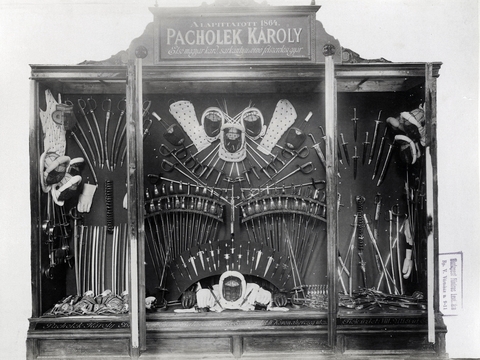
 A manufacturing company established by Károly Pacholek in 1864 was famous for its swords, fencing equipment etc. At the Millennial Exhibition in 1896 the company displayed a wide range of their products. [3]

1896

A well-known fencing master
Lajos Vermes (~1896)

 Even as late as in 1917 we can recognize this gear in a military manual for Hussars. (The third edition.)


1917
 
 And finally a photo from a Hungarian exhibition (2016) detailing the development of sabre fencing between the late 18th century and the establishment of Ludovika Military Academy. Several drawings from Sebetic's book (1886) can be recognized. (Fig. 1-5 from his book.)

Old headgear & Sebetic (1886)
________________________
  1. Link to the item.
  2. Link to the original.
  3. Fortepan Collection.