Showing posts with label XVII. sz.. Show all posts

2020-12-19

Face mask (~1625)

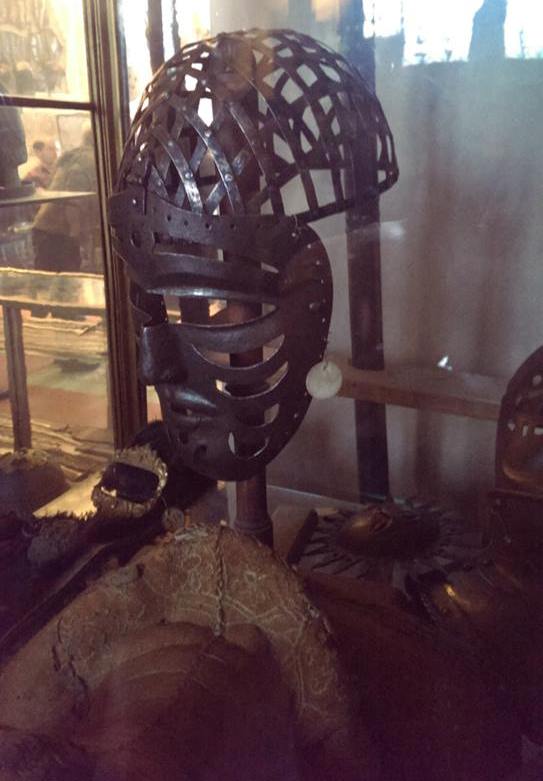
 It seems that the first known depiction of a plate fencing mask with ties is from 1686 [1] . However there are some tantalizing signs that protective masks were used several decades earlier. Below we could examine two face masks from the Stibbert Collection (Florence). The first mask is a rather interesting one, because it is difficult to say for sure: Was this mask a decorative one (resembling Venetian masks)? Or was it used for some other purposes e.g. fencing?!


 The second one, simply placed in a gorget by a curator or originally attached to a gorget, is especially interesting, because it matches really close the description of the object from the Pennsylvania Museum.


Purchase of European Armor

 The Museum's collection of European armor has been greatly strengthened by a recent purchase of fourteen specimens acquired at an important sale in New York. [...] The most striking piece in the group is a French fencing mask of 1625. It is embossed with the verisimilitude of a face with long mustachios and a Louis Trieze pointed beard; the mouth and eye openings have upraised borders, to deflect the stroke of the opponent's blade; the eyelids, beard, and mustachios are ornamented with roping.” (Page 24) [2][3]

Accessions October, 1921 - February, 1922
Class: ............... Armor
Object: ............ Fencing mask, French, 1625
Source: ............By purchase, Keehmle Fund and Bloomfield Moore Fund” (Page 29)
________________________________________
  1. Fencing Material Culture (2014)
  2. THE PENNSYLVANIA MUSEUM BULLETIN * PUBLISHED AT MEMORIAL HALL. FAIRMOUNT PARK, PHILADELPHIA, BY THE PENNSYLVANIA MUSEUM AND SCHOOL OF INDUSTRIAL ART NUMBER 70 FEBRUARY, 1922
  3. This bulletin is marked with a library stamp: „Philadelphia Museum, Library, College of Art”.

2020-06-27

Strangest

 This might be the strangest sword I have ever seen so far... OK, to say ever can be a bit of exaggeration, but it is definitely true for this year. It could be the top nominee for the Strangest Sword of the Year award.


 I have found a short description of this item, and fours photos at an auction site [1] while searching for Chinese jians sword of Qin dynasty. So it is fair to classify it as a completely random find!


 The description from the auction site provides us with the following: „Lot 34 A RARE EAST EUROPEAN SWORD HUNGARIAN OR POLISH SECOND HALF OF THE 17TH CENTURY Broad flat double-edged blade with rebated tip the lower half etched on both sides with an heraldic crest surmounting a classical portrait bust and a Latin inscription differing over the respective sides with iron crosspiece formed with button tips and upper and lower langets flat beak-shaped cap-pommel canted downwards at its front original grip bound with leather over cords and the blade tang secured by a lateral rivet on iron rosette washers.

Overall length is 37.5 inches, 95 cm, blade: 32 ? inches (83 cm).
Very good condition. Blade has a chip towards the tip and minors scratches


 So what we have here? Basically a strange mixture of features:
  • a straight broad blade;
  • which is double edged;
  • and without a tip (rebated);
  • a very recognizable sabre hilt (a long crosspiece, langets etc).
 Also there is a well visible dent on the working edge of the sword, near its tip. The most intriguing question: Who might have used this sword? The blade itself has all characteristics of an executioner's sword: a) straight; b) double edged; c) with a round tip. So this is one real possibility. Another -- a less probable -- option, that its owner was a Hussar who wanted an Turkish straight sword, but in this case it is rather difficult to explain the round tip of the blade.
__________________________________

2020-01-04

Breaking

  Is it possible to break a steel sabre on your knee?

 There is an interesting and emotional scene at the end of Born for the Sabre docudrama: the protagonist, Blazej Wronowski, Polish nobleman is breaking the steel blade of a sabre on his knee.


 It seems that this is the biggest blunder of Zrodzeni do szabli, remarkably nicely filmed and well directed Polish dramatised TV film. Let me explain why I think so. At the moment I don't have at my disposal any technical calculations to prove the physical impossibility for a human being to perform such a feat, but we know from the historical records how such things were actually performed.

  „A New York Times article on the “Degradation of Dreyfus” on Jan. 6, 1895, reveals the answer: “To prepare for stripping the prisoner of his insignia of rank, the prison tailor yesterday removed all the buttons and stripes from Dreyfus’ tunic, the red stripes from his trousers and the regimental number and braid from his collar and cap. These were all replaced with a single stitch so that they could be torn away readily. The condemned man’s sword was also filed almost in two, in order that it might be easily broken. The Adjutant’s quick movement and apparent effort in breaking the sword was consequently mere pretense, as only a mere touch was necessary.”” [1]

  Another good example is the degradation ceremony (cashiering) of officers who participated in the Decembrist revolt (1825).

A. Dolinin [2]

  In this Russian text Dolinin quotes from the Jakusin's memoir [3]: „...I was the first on whom the  execution (of the degradation ceremony) started. The sword, that should have been broken above me, was inappropriately filed; the soldier hit my head with full force, but it didn't break; I fell. „If you repeat this again, you will definitely kill me” - I told him.” [4]

  From the above sources it is absolutely clear that only after having filed -- almost completely -- the blades those sword were broken. But when the filing was not performed carefully enough, swords were broken only after several attempts, and by applying considerable force.
____________________________________
  1. Source.
  2. Александр Долинин: Комментарий к роману Владимира Набокова «Дар». 2018. ...........(A. Dolinin: Commentaries to Vladimir Nabokov's novel The Gift.) Dolinin is a historian of Russian literature.
  3. Some sources say Jakusin, some say Jakubovich was the officer.
  4. During his military service in Caucasus he had a serious head injury.

2019-12-16

...do szabli

  On Tuesday a long-awaited Polish film -- Zrodzeni do szabli (Born for the Sabre) -- will be shown on History Channel. Hungarian viewers will also have the possibility to watch this interesting documentary-drama about sabre fighting, the Polish-Lithuanian Commonwealth.

From IMDb (3 of 16 photos)

  It is very easy to find -- at least -- two trailers for this film, however in this entry I wouldn't like to discuss those excellent trailers, but rather I would prefer to share several nice drawings of painter-reenactor Anatoly Telenik, who worked on the film's concept.


And at this time we invite you to familiarize yourself with the conceptual drawings of Anatoly Telenik. Among other things, this is how it started! Everyone who wants to see the final effect are welcome in front of TV!” [1]


  First I saw these drawings in the YT video -- Zrodzeni do szabli | Fakty o polskiej szabli --, which explains the basic facts about the Polish sabre, but later I have found them on the film's FB-page. For the readers it might be interesting to find out more about Telenik, and see more of his excellent drawings.

Anatoly Telenik [2]

Update:
  After having watched the film it is really entertaining to re-examine the photo from IMDb.

 There we can see -- from left to right -- the several major characters: the protagonist, Blazej Wronowski (played by Bartosz Sieniawski),  Jan Jerlicz, war veteran and Blazej's fencing teacher (played by Pawel Delag, who also directed this film), and the antagonist, Russian bad guy, Dymitr Repnin (played by Krzysztof Sieniawski, identical twin brother of Bartosz). One would say it is completely charming how a little disguise -- some hair there, a shaved head here -- could make identical twins look so different. Well done!

  Bartosz holds in his left hand the upper part of the broken sabre from one of the last scenes.
________________________________________
  1. From the FB-page of Zrodzeni do szabli.
  2. Source.

2019-03-01

Karabela 2.

  Egy szép karabela Zablocki könyvéből (45. o.; a szerző besorolása szerint: IIa), a kard egy varsói magángyűjteményben található.


Egy lengyel karabela a XVII. sz. második feléből [1]

A kard fontosabb adatai:
  • a penge hossza: ................................ 825 mm,
  • ívmagassága: ................................... 75 mm,
  • súlypontja: ....................................... 240 mm (a keresztvastól számítva).
Summary:
A nice Polish karabela from Zablocki's book, the second part of the 17th century. Main parameters of the blade: lenght, curvature, PoB.
_____________________________________________

  1. A kép eredetije. (Lengyel magyarázó szöveg.)

2019-02-01

Husaria

  A lengyelek így nevezik a huszárjaikat.

 Ezzel folytatódna a páncélos huszárok szárnyairól elkezdett társalgás (lásd a VMH topikot). Egész pontosan arról, hogy hova is szerelték fel ezeket a tartozékokat. Talán azzal lenne érdemes kezdeni, hogy a kora újkori, menő martalócok szívesen díszítették magukat szárnyakkal. Ez a szokás a különféle reguláris csapatoknál is megjelenik, pl. a szpáhiknál. Szárnyak, tollak kerültek a tárcsapajzsra, annak csúcsára.

 A topikban be lett mutatva pár olyan kép, amikor csak egy szárnyat látunk a huszárokon (1605).

 Egy igen érdekes változatot lehet megfigyelni egy 1616-os metszetsorozaton, ami a württembergi herceg fiának születésekor megrendezett lovagi torna részvevőinek felvonulását ábrázolja. [1]

Alkarra szerelt változat (78. o.)

Egy másik oldal (77. o.)

  Különböző lengyel, orosz wikipédiás szócikkekből kiderül, hogy folyamatosan változott a szárnyak rögzítésének helye. „Otóż o wiele częściej skrzydła lub skrzydło (zwykle bowiem używano jednego) mocowano do tylnego łęku siodła i to już po zajęciu przez husarza miejsca w siodle, w przeciwnym wypadku przeszkadzałoby to w dosiadzie. Bardzo często też używano skrzydeł tylko na popisach i paradach.” [3] Ebből az derül ki, hogy általában egy szárnyat használtak a nyereg hátsó részére szerelve, és azt is csak katonai szemléken vagy felvonulásokkor. Egy másik szócikk arról ír, hogy a régi huszárpáncél (typ starszy) időszakában (1640-1675) a nyeregre volt szerelve a szárny, később az újabb páncéltípus (typ mlodszy) megjelenésével pedig a hátvértre került át (1675-1730). Gyakran csak egy tapasztalt szakember tudja megkülönböztetni a páncélzat két típusát.

Huszárló [2]

  Per pillanat itt tart a kulturális kalandozásunk.

Summary:
  Where exactly those special wings of the Winged Hussars were attached? On the saddle? Or on the backplate of Hussar armour? The Hussars were famous for their huge "wings", a wooden or later metal frame carrying eagle, ostrich, swan or goose feathers. Historically both locations were used to attach those special features.
_________________________________________________

  1. Repræsentatio der Fvrstlichen Avfzvg vnd Ritterspil... Stuttgart, 1616, 77-78. o. 
  2. Illusztráció egy lengyel lexikonhoz (Encyklopedia staropolska ilustrowana), 1900-1903.
  3. Wiki: Husaria

2018-04-21

Perzsa penge

Egy szép perzsa penge


Orosz markolattal [1]

___________________________________________________________
  1. Ismert a szablya tulajdonosa: Dmitrij Ivanovics Godunov (-1606), a cár rokona. A penge fokán szerepel az orosz felirat (neve, udvari címe). Viszonylag pontosan megállapítható az ajándékozás időpontja (1598-1606), sőt ez még tovább szűkíthető.

2017-12-04

Átlagok

   Damjanich János egyik hatalmas kardja kapcsán jegyezte meg az egyik kollega: „Valahogy nem lep meg, hogy soha nem vesztett csatát, eléggé felemelő lehetett egy ekkora vaddisznó ember mellett harcolni :) Meg elég demoralizáló lehetett az ellenfélnek, amikor repkedtek a végtagok körülötte :)

  Még mielőtt túlságosan beleélnénk magunkat a csatában repkedő végtagok vizionálásába, érdemes szembesülni azzal a ténnyel, hogy a konkrét kard az egy díszkard, amit Damjanich özvegye adományozott egy múzeumnak, és amit a tábornok soha nem használt csatában, legalábbis a nyilatkozó múzeumi kurátor szerint. Ez a szablya az Aradi Emlékmúzeumban található, és a riport időpontjában egy időszaki kiállításra érkezett Gyulára. [1]

Képek: penge | teljes kard |

  Amikor ilyen extrém méretekkel rendelkező szablyákat lát az ember, akkor hasznos lehet felidézni, hogy milyenek voltak az átlagos kardok egy-egy korszakban. Ehhez Kovács S. Tibor kiváló könyvében - Huszárfegyverek a 15-17. században (2010) - találunk hasznos adatokat:

A magyar szablya tömege fokozatosan csökkent, a 16. század közepi 1 kg-ról a 17. század első felében 0,8 kg-ra, míg a század végén 0,6-0,7 kg lett a szablyák átlagos súlya. A 16. század közepe táján alakult ki a jellegzetes magyar huszárszablya, amely formáját - kisebb változtatásokkal - egészen a 18. század elejéig megőrizte.” [KST, 111]

Példák:  
  • 16. század közepe: Zrínyi szablya (1563, 1,15 kg); Bebek György (+1567) szablyája:  hossza 94 cm, penge szélessége 3,3 cm, tömege 1,01 kg [KST, 89];
  • 17. század első fele (inkább közepe): hossza 94 cm,  penge szélessége 3,7 cm, tömege 0,78 kg [KST, 95]; Rákóczi László (1633-1664) oldalfegyvere: hossza 101 cm,  penge szélessége 4,4 cm, tömege 0,84 kg [KST, 95]
  • 17. század vége: hossza 98 cm,  penge szélessége 3 cm, tömege 0,69 kg;  hossza 92 cm,  penge szélessége 2,9 cm, tömege 0,69 kg [KST, 107].
___________________________________________

1. Az egyik riport a gyulai kiállításról

2. Egy másik riport (Két hét alatt kétezren nézték meg..., YT)

2016-06-19

Spanyolok vs törökök

Természetesen nem a D-csoport spanyol-török meccsére (3:0) kell gondolni, bármennyire is erre koncentrál mostanában a magyar férfitársadalom jelentős része. Hanem pl. arra, miket írt 1600-ban Luis Pacheco de Narváez (1570–1640) ibériai vívómester a spanyol rapier használatáról a török szablyával szemben. Eddig nem sikerült megtalálni a teljes spanyol szöveg rendes átiratát vagy angol fordítását (csupán a III. fejezet - 88-133. o. - fordítását készítette el Tim Rivera 2013-ban).

A könyv címe: Libro de las grandezas de la espada: en que se declaran muchos secretos del...


A gonosz El Turco (egy török vitéz) [1]

A számunkra érdekes rész a könyv 233. oldalán kezdődik, és több oldalon keresztül foglalkozik a témával (a fejezetben még több kép is van).

"Tratado Particular,
en que se manifesta como se afirman los Turcos: y se avisa como se defender a el que traxere espada, de un Turcoi su alfange. Es punto muy importante y curioso
.

[Az oldalon egy széljegyzet is található]
Contra el alfange, arma ordinaria del Turco, no vale las tretas de la vulgar destreza.

El intento que particularmente hemos llevado en este primer libro, ha sido, aui faros de sola la espada y sus proposiciones, contra otra espada sola; y queriendo concluir con lo universal, me parecio hazer este tratadillo de no poca importancia; y esto movido de una justa consideracion, de ver que nuestros antiguos y mortales enemigos los Moros y Turcos por momentos vienen con nostros a las manos; y es caso que me ha puesto admiration que con fer esto cierto y hallarse en este peligro muchas veces (vezes); ni ha auido dicipulo que pida, ni maestro que ensene el remedio que se podra contra los tales.

Pero no ai que culpar, porque como contra el alfange no aprovechan las ganacis, ni posturas altas, ni las tretas del tentar por defuera, ni por de dentro, por que su postura es desigual
..."

Nyersfordítás:
"Particular Treaty,
that is manifested as the Turks assert: and defend warns as that traxere sword, a Turcoi his cutlass. It is very important and interesting point.

Széljegyzet:
Against cutlass, ordinary weapon Turkish, not worth the trickery of the vulgar skill.

The attempt to have particularly taken in this first book, has been one AUI headlights sword and his proposals, against another sword alone; and I wanted to conclude with the universal, I found this little treatise hazer not inconsiderable importance;

and it moved a fair consideration, to see our old and mortal enemies the Moors and Turks at times they come with us to the hands; and is case that has put me fer admiration with this certain and be in this danger many times (vezes), nor to ask auido dicipulo, no teacher to teach the remedy may be against such.

But no ai to blame, because as against cutlass not take advantage of ganacis or high positions, nor tempted by the wiles of defuera, nor inside that its position is unequal..."

Annyit sikerült kihámozni, hogy a szerző szerint a török szablyával szemben nem működnek a destreza vulgar (las tretas de la vulgar destreza) vívóakciói, amit talán nevezhetnénk ottani utcai vívásnak. Most jönne a következő lépes: annak kiderítése, hogy vajon mi működik a szablya ellen? No, ehhez kellene némi spanyol nyelvtudás vagy egy ismerős...
____________________

1. El Turco, como se afirma, y como se le ha de herir. The Turk, as stated, and as he has hurt.    Amennyire tudtam, megpróbáltam elolvasni a spanyol szöveget, ami tele van trükkös rövidítésekkel... A spanyol szöveg után következik a Google által készített nyersfordítás.

2. Rövidítések - a szokásos kora újkori: f=s, v=u, aztán helyi specialitások: co~ = con, q~ = que, z=c, y=i.

2014-05-21

Török kor (2.)

A végvári vitézeink szablyavívásával kapcsolatban nagyon-nagyon kevés adatunk van, legalábbis jelenleg. Ezért olyan értékes minden apró morzsa, ami segít abban, hogy jobban értsük a török kor vívását.

 
Egy kép Sebastian Heußler (Heussler) Neu Kunstlich Fechtbuch (1615) könyvéből.

"Sebastian Heußler was a 17th century German Freifechter. A native of Nuremberg, Germany, he was the eldest son of printer Leonhard Heußler, and as a youth he was trained in his father's craft. It is unclear if he was apprenticed to Christoph Lochner, but he was working as a type-setter in Lochner's workshop by 1599. He married Sabina Prünsterer in 1601 and purchased a house in Nuremberg in 1603. Heußler probably certified as a master printer during this time, and he was listed in the records of the printing guild from 1601-04 and again in 1607.[1]

In 1608 at the age of 27, Heußler abandoned his craft and henceforth devoted himself to studying the Chivalric Art of Fencing that had captivated him since childhood (he may also have been studying fencing during his sabbatical from printing in 1505-06).[2] Heußler seems to have originally been a student of Hans Wilhelm Schöffer von Dietz, the fencing master of Marburg, which is also where his education in the style of Salvator Fabris began.[citation needed] He ultimately left his native Germany, where he said that the arts were less cherished, and traveled through Italy, France, England, and the Netherlands.[3] Heußler is described as both a Kriegsmann (man-at-arms) and monatsreiter ("month-rider"), which seems to indicate that like many fencing masters he supported himself as a mercenary.[4] He likely held the elite position of color guard in his unit,[2] as he would later author a book on the art of flag-waving. It's questionable how much time Heußler spent in Nuremberg after 1508; he moved his wife to a new home in 1615, but in 1617 when the old home was sold, his wife negotiated the deal in his absence.[4]

In 1615, Heußler authored a fencing manual entitled Neu Kunstlich Fechtbuch ("New Illustrated Fencing Manual"), illustrated by noted Nuremberg engraver Gabriel Weyer and printed by the son of his former master, Ludwig Lochner. The book treats the use of the rapier, a system described as being in the style of the famous Italian masters Ridolfo Capo Ferro da Cagli and Salvator Fabris.[3] The following year he co-authored his New Kůnstlich Fahnenbůchlein ("New Illustrated Flag-Waving Manual") with Johannes Renner. Heußler's fencing manual was apparently well-received, and was reprinted at least five times in different forms over the subsequent twenty years.

Little is known of Heußler's life after the publication of his books. Some sources assume him dead by 1630, but there is record of a General Sebastian Heußler serving the King of Denmark in 1645;[4] it cannot be determined at this time whether this is a reference to the fencing master or not.
"

Forrás: Wiktenauer

2014-05-13

Rokonok


A kép szerkesztője a középkori falchionok típusait próbálta bemutatni, de az eredmény egy kissé vegyesre sikeredett. A legfelső tényleg egy falchion (valószínűleg a Thorpe), utána egy jellegzetes XV. sz. magyar szablya következik, fokéllel, S-keresztvassal [1], utána négy darab olasz storta (ottani falchion). A legalsó kettő pedig dussack (teszak): kardpenge, komplex markolat, ellensúlyként szolgáló markolatgomb (XVI. sz., a leírások szerint ilyenből sok van pl. Grazban). (Lásd a Dusägge bejegyzést)

Dussack (myarmoury):  1610 körüli dussack [2]

Frissítés: 2016. június 14.; 2017. december 19.
_________________________

1. Kovács S. Tibor, 66-67. o. "S" keresztvasú szablyák, 15. század (MNM Fegyvertár).

2. Lehet, hogy ez inkább egy storta. Eléggé eltér egy stájer szablyától (Dusägge).