Showing posts with label orosz. Show all posts

2021-04-06

Ibn Fadlan

  In 2017 a magnificent Russian book was published on ibn Fadlan's journey to the Volga River in 922. It is basically a good summary of the whole journey, its historical context, including the new translation of his Risala, plus a really nice exhibition catalogue of different items related to the nations visited by Fadlan during his journey. 

 Short Russian summary of Путешествие Ибн Фадлана. Волжский путь от Багдада до Булгара. Каталог выставки (2017): „Каталог подготовлен к выставке «Путешествие Ибн Фадлана: Волжский путь от Багдада до Булгара», посвященной культурам народов, по землям которых в 921–922 гг. прошла миссия багдадского халифа ко двору царя Волжской Булгарии. Секретарь этой миссии Ахмад ибн Фадлан оставил бесценный источник по этнографии и истории современных ему народов от Средней Азии и до Средней Волги, а шире – всей лесной зоны Восточной Европы. «Книга» Ахмада ибн Фадлана, известная специалистам с XIX в., является хрестоматийным сочинением, откуда мы черпаем уникальные сведения для реконструкции истории части народов, населявших Восточную Европу в эпоху формирования Древнерусского государства. Настоящее издание открывается новым переводом этого выдающегося источника. Выставка, включающая в себя более пятисот экспонатов, как отдельных предметов, так и целых комплексов, показывает мир эпохи Ибн Фадлана, причем не только тех народов, по территориям которых пролегал маршрут миссии, но и тех, которые входили в состав или находились под их влиянием. Выставка демонстрирует разные сферы жизни средневековых обществ, с которыми сталкивался Ибн Фадлан во время своего путешествия. Среди экспонатов выставки большое количество памятников декоративно-прикладного и ювелирного искусства народов Восточной Европы, замечательные произведения керамистов и стеклодувов Ближнего и Среднего Востока эпохи. Большинство предметов экспонируется впервые. Издание адресуется как специалистам, так и всем интересующимся историей и культурой средневековья.” [1]

 Several richly decorated Alanian sabres (11-12th century) can be found among those items.

Page 294: item 213 [2]
 
Specification: total length -- 90.0 cm; blade -- 78 cm; length of false edge -- 24 cm; width near the crossguard -- 3.5 cm.

Page 304: item 227

 Specification: total length -- 101.0 cm; crossgard -- 8.0 cm; width of scabbard -- 4.0-4.5 cm.
___________________________________________
  1. Partially available: https://books.google.hu/books?id=4rw9DwAAQBAJ
  2. Closeup of the crossguard (from a 2018 post).

2020-06-18

Stab test

  Russian re-enactors created an entertaining and historically accurate video (2017) about the protective features of riveted chain mail (the 4-to-1 pattern) against different medieval weapons.  


 They tested several types of chain mail:

Chain mail (A)

10 kg -- wire thickness: 1.2 mm, ring diameter: 10 mm (A)
14 kg -- wire thickness: 1.6 mm, ring diameter: 11 mm (B)
15 kg -- wire thickness: 1.6 mm, ring diameter: 12 mm (C)
18 kg -- wire thickness: 2.0 mm, ring diameter: 12 mm (D)

 Naturally cuts -- slashing cuts -- were not very effective against this personal armour. As expected they failed to penetrate the chain mail at all, but their impact could have caused serious blunt traumas to warriors wearing chain mail. Thrusts with a sabre, and later with a straight sword having pointy tip penetrated chain mails rather easily. How much the blade had penetrated the armour, depended on the characteristics of a particular sample. 


Chain mail (A) against a sabre [2]

 In this particular case we can see a really deep penetration, somewhere around 20-25 cm, which could have caused a mortal wound. 

An approximate length of the blade 
which penetrated the chain mail sample (A)

   The thickest chain mail (D) against the pointy straight sword (1.5 kg).


This much!

  Most definitely one wouldn't want to have so much steel through his chain mail.
_______________________________ 
  1. It is better to use the term chain mail, because ring mail is a different type of armour: „an assumed type of personal armour constructed as series of metallic rings sewn to a fabric or leather foundation”. (Wiki) Also it is advisable to avoid the term scimitar.
  2. In the video they called it Horde sabre (0.7 kg), meaning that is a replica of a sabre used by warriors of the Golden Horde.

2020-03-18

Glebovich (1883)

  A rather short, but nevertheless interesting Russian fencing treatise from 1883.

Fehtovanie na espadronah... [1]

Fig. 3, 4

Fig. 13, 14

Fig. 15-19

(to be continued)
_________________________________________________
  1. Fencing with training sabres. Sankt-Petersburg, 1883.
  2. Espadron = training sabre in Russian military parlance. 


2020-02-08

Revisited

  In 2016 -- based on the information from a Russian homepage -- I wrote a post entitled Sport? Duel?, about two nice sabres, which are shown below. 

Duelling sabres?!

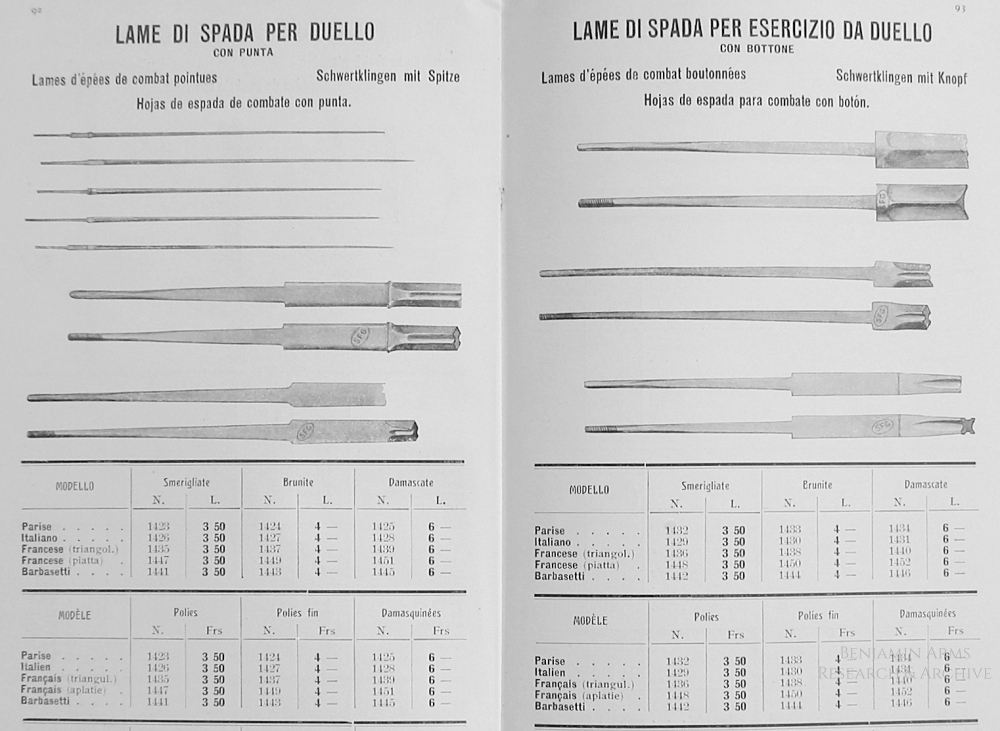
 The Russian text claimed that they are duelling sabres: German (left) and Italian; also it provided a fairly detailed description of swords, and their specifications (overall length, blade length, width, weight). During past years much more information has been available on different training swords, so with a certain level of confidence I would say that these two sabres are Parise type swords (Model 1 and Model 2). 

  Let's start with the second sword: an Italian duelling sword from the second half of the 19th century, according to the Russian description. It has a manufacturer's marking (SFG), [1] and an inscription can be read on the left surface of the blade „К ASANIELU PARISE”. This is a corrupted form of Masaniello Parise (1850-1910), famous Italian fencing master, director of Scuola Magistrale in Rome. This is his second model of fencing sabre.

 An excellent table [2] provides us with the very detailed information :

(108) 

Hilt type: ............................ Parise 2nd model
Blade type: ......................... Parise Curved 13 mm
Country: ............................. Italy
Owner: ............................... Sam Campbell

Blade length: ....................... 85.5cm
Overall length: ..................... 101.5cm
Fuller length: ....................... 51.5cm
PoB: ................................... 4.4cm

Total weight: ....................... 441g
Blade ................................. 169g
Guard ................................ 178g
Backstrap ........................... 0 ........ (because this grip doesn't have a backstrap)
Grip ................................... 38g
Ferrule ............................... 2x18g
Nut .................................... 24g

Curvature: ......................... 15mm
Width: ............................... 13.6mm (at ricasso)
Tip: ................................... 6mm
Thickness: .......................... 6.5mm (at ricasso)
Tip .................................... 0.6mm
Halfway.............................. 3.5mm

The Russian source gave us the following: overall length: 1028mm,  blade length: 857mm, width (presummably at ricasso) 19mm, total weight: 630g. So a sturdier blade with a Parise Mod. 2 hilt could have been used as a duelling sabre. [3]

  The first sword is said to be a German duelling sabre. The German origin is fully supported by marking „WEYERSBERG & STAMM SOLINGEN”. By studying different resources it is obvious that this hilt is Parise 1st model.

(7) 

Hilt type: ............................ Parise
Blade type: ......................... 18 mm
Country: ............................. Italy
Owner: ............................... Kevin

Blade length: ....................... 86.5cm
Overall length: ..................... 102.2cm
PoB: ................................... 12cm

Total weight: ....................... 596g
Blade .................................. 300g
Guard ................................. 205g
Backstrap ............................ 55g
Grip .................................... 26g
Ferrule ................................ 6g
Nut ..................................... 4g

Curvature: .......................... 15.22mm
Width: ................................ 18.67mm (at ricasso)
Tip: .................................... 12.43mm
Thickness: ........................... 5.39mm (at ricasso)
Tip ..................................... 1.53mm
Halfway............................... 3.95mm

  The Russian source gave us the following: overall length: 1012mm,  blade length: 846mm, width (presummably at ricasso) 16mm, total weight: 700g.

  So based on the above date we cannot exclude that these swords are indeed duelling sabres, but it is also quite clear that both hilts are Parise type hilts.
___________________________________________
  1. Italian manufacturer: SFG = Serafino Fratelli e Gnutti (A catalogue page.)
  2. Sabre Measurements. (Table.)
  3. In the table there is another Parise 2nd model -- owned by Stephen Fisher -- manufactured by Horster, which weights 635g.

2019-11-04

Testing

  In 2016 I found an informative picture showing how Russian bladesmiths tested finished products in 1827 at the famous Zlatoust weapon factory. A short Hungarian post was written about it.


 A few days ago I stumbled across a Russian video on blade testing at a factory in Ivanovo (Russian Federation, ~250 km from Moscow). [1]

A very bad method of testing blade flexibility [2]

The appropriate test [3]

  During this test the tang is fixed, the blade itself is positioned along a straight line, and the position of the tip is marked by a nail, then the tip is moved 100 mm away from the line (a GOST requirement), after this bending it should return to the original position, when the tip is released. At the factory they perform more severe tests than the one required by the relevant state standard, for example they bend the tip almost to 30⁰.

  It was really interesting to see real similarities between the old and contemporary testing methods.
___________________
  1. General description of things that will be shown, then measuring the hardness of a blade (~56-58 HRC) [3:38-5:04], then hitting several times a sturdy table with the flat of the tested blade [5:44], bending the blade [9:39] etc.
  2. As the Russian engineer has explained in the video: this is a really bad method to test the flexibility. It has only one purpose, namely to impress non-specialists. Nevertheless they performed this test to show us that the their blade can withstand even this kind of abuse, without any deformation.
  3. GOST 2002 (State standard): Bladed weapons for Cossacks... [7:51]

2019-05-01

Shashka 2.

  As promised a series of blog posts on Cossack shashkas is continued. 

  Today we could study a nice drawing of so-called “Nizhegorodka” shashka M1834. [1] In that year shashka was officially adopted by the regular Russian troops. The author of the article writes: „These shashkas were still very similar to traditional Caucasian samples with the hilt of two wooden pieces. A steel or brass ring was added to protect the grip.”

Side view & several crosssections of the blade

  He continues: „The hilt was not embedded into the scabbards, so it was called “Asian” pattern, while those shashkas, popular among irregular Caucasian cossacks, which hilts embedded, were called “the Caucasian pattern”. Note that there is a hole for a knot – unlike traditional Caucasian shashkas. Scabbard is wooden, covered with leather, with a brass mouth, two scabbard bands with loose rings for a belt and two bands with mounts for bayonet. Initially there were no a chape on the scabbards, later it was decided to install it.

Side view of the scabbard

  Later some other regiments and units adopted it. This pattern was used till 1917. It was rather successful and popular pattern. So much so that when in 1881 a new shashka pattern replaced the P1834 in Nizhegorodsky and Seversky dragoon regiments, the soldiers disliked it, resented, and soon P1834 was returned them.”

  In the second picture there is a remark that the location and dimensions of the bayonet fittings are from a particular document N 157-1895. So it is clear that it was added in or after 1895, and the Model 91/30's cruciform bayonet is for the famous 3-line rifle M1891. [2]

  Specification (from [3] ):
  • Total length ........................................... 1000 mm;
  • Blade length .......................................... 880 mm;
  • Blade width ........................................... 34 mm;
  • Blade curvature .................................... 70/395 mm;
  • Weight .................................................. 877-939 g

___________________________________________________
  1. Nizhegorodsky dragoon regiment (Нижегородский 17-й драгунский полк).
  2. (Russian: трёхлинейная винтовка образца 1891 года), colloquially known in the West as Mosin–Nagant and in Russia as Mosin's rifle is a five-shot, bolt-action, internal magazine–fed, military rifle developed from 1882 to 1891, and used by the armed forces of the Russian Empire, the Soviet Union and various other nations. It is one of the most mass-produced military bolt-action rifles in history with over 37 million units having been made since its inception in 1891.
  3. Федоров: Холодное оружие. с. 70-71.

2019-04-12

Shashka hilts

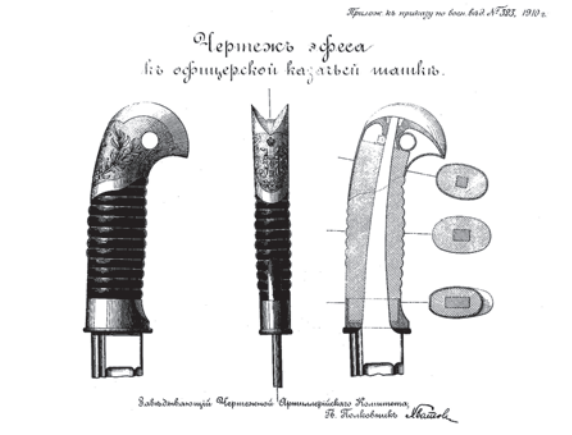
  I assume that the wast majority of Russian readers visit this blog to find some shashka related stuff. So this post is exactly for them. A few days ago I found an excellent article written by a Russian HEMA researcher. [1]

Details of Cossack shashka (M1910)

  Russian visitors could easily read the text: drawings of the hilt of Cossack officer's shashka, approved by His Majesty etc. etc.

Dragoon officer's shashka (M1881, 1909)

  This is an interesting shashka type - one which has a hand protection feature: single knuckle bow. Usually shashkas don't have such a protection.
________________________________________
  1. Soon I will indicate the author's name, and the location of this very good article.

2019-03-11

Kuban

  A Hungarian archeologist visited several museums of the Kuban region (Anapa, Krasnodar) in order to find artifacts that could be connected to the time of the Hungarian Conquest of the Carpathian Basin (around 895). 

Fittings of a sabre scabbard (Krasnodar)

 Unfortunately all these artifacts were found by local grave robbers so no proper archaeological context can be established.

A sabre from a private collection [2]


  It is interesting to observe three spikes on the inside curve of the sabre handle. Sometimes we can see very similar spikes on sabres of the Saltovo-Mayaki culture.
_____________________________________________________

  1. These pictures are parts of the screenshots from a Gabriella Lezsák's YT video about her two visits to the Kuban region of the Russian Federation in 2016 and 2017.
  2. Artifacts from the Kuban region in Mardjani Collection (Moscow).

2018-04-21

Perzsa penge

Egy szép perzsa penge


Orosz markolattal [1]

___________________________________________________________
  1. Ismert a szablya tulajdonosa: Dmitrij Ivanovics Godunov (-1606), a cár rokona. A penge fokán szerepel az orosz felirat (neve, udvari címe). Viszonylag pontosan megállapítható az ajándékozás időpontja (1598-1606), sőt ez még tovább szűkíthető.